

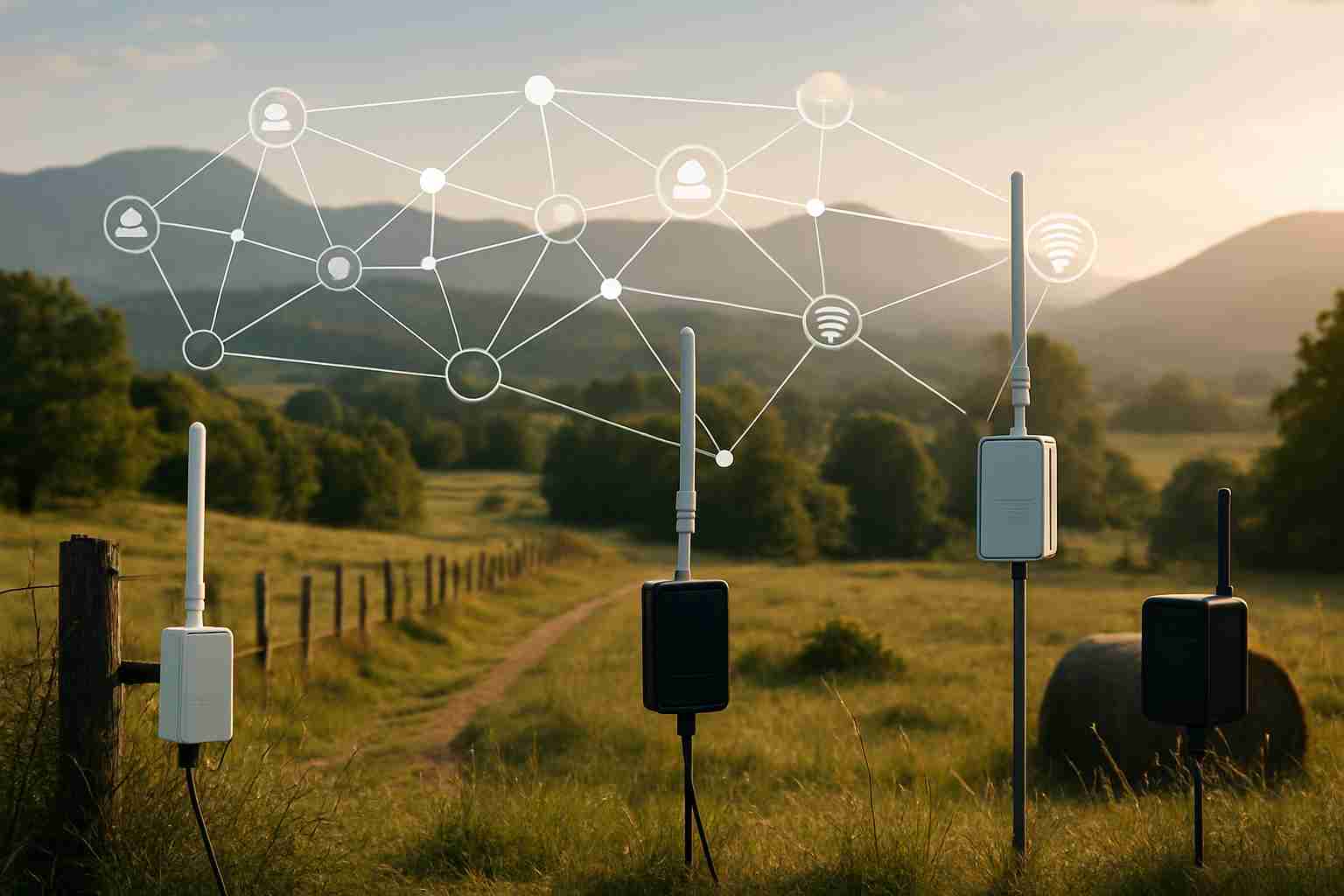
In today’s pursuit of trustworthy, extended-distance wireless transmission that doesn’t depend on traditional infrastructure, LoRa mesh networks have proven to be an effective autonomous communication technology. As wireless innovations progress, these networks provide a novel method to sustain communication in isolated location connectivity scenarios, improving accessibility and fostering distributed messaging infrastructures.
The Basics of LoRa Mesh Networks
LoRa (Long Range) technology plays a crucial role in building distributed wireless networks, especially for remote communication systems. Utilizing energy-efficient communication systems that transmit signals over extended distances, LoRa vastly enhances communication reach in places lacking conventional networks. Fundamentally, a LoRa mesh network is composed of gateways and nodes. Acting as intermediaries, gateways link these nodes to expansive networks, while the nodes themselves relay information between one another across the system. Together, they create a self-organizing wireless networks framework capable of covering large areas without relying on heavy infrastructure. Devices such as the Lora mesh device for off grid facilitate smooth communication over broad terrains, whether in remote countryside or rugged mountainous zones.
Thanks to the interconnected nodes, data transfer remains dependable, forging robust wireless networking that adjusts to diverse environmental challenges. While each node functions autonomously, they collectively bolster the network’s stability. The value of these mesh systems lies in their autonomous operation, making them indispensable where traditional power and network services fall short. As communities increasingly seek sustainable and inventive communication strategies, embracing technologies like LoRa opens promising avenues for independent communication solutions.
Advantages of LoRa for Off-Grid Communication
LoRa technology offers several notable benefits for off-grid communication, primarily due to its adaptability and efficiency. Operating with low power consumption—a vital feature in remote communication systems where energy is scarce—LoRa significantly prolongs the lifespan of network devices, allowing for sustained operation with little upkeep. Compared to traditional communication networks that require extensive infrastructure, LoRa networks need minimal installation, enhancing affordability and ease of access.
In addition, LoRa’s capability to cover broad regions without depending on conventional infrastructure makes it perfect for various settings. Whether it’s remote rural areas requiring cost-effective rural connectivity solutions or urban environments seeking innovative independent communication solutions, LoRa stands out. Its impressive range improves communication in locations that other networks struggle to serve.
For practical implementations, products such as the Lora mesh device for off grid prove essential. Using a mesh wireless infrastructure, these devices enable reliable communication without relying on centralized control. This adaptability ensures dependable operation even in difficult terrains, meeting network demands with both reliability and efficiency. The release of the Lora mesh device for off grid further highlights LoRa’s potential to transform communication across diverse landscapes and requirements.
Decentralized Mesh Networks Explained
Decentralized mesh networks offer a strong communication alternative where traditional infrastructure is absent. Operating by linking numerous devices into a web-like formation, these networks guarantee that data can travel through multiple routes. By removing a single point of failure, this architecture greatly improves reliability, maintaining uninterrupted communication even if some devices fail. Each node within this distributed wireless network acts autonomously, distributing the duty of data forwarding. This peer-to-peer wireless networking not only enhances the system’s durability but also increases security by avoiding a central point vulnerable to attacks.
Incorporating LoRa technology into these systems allows individuals and communities to establish autonomous communication technologies. Through a LoRa mesh device for off grid, these self-sufficient communication networks can span vast areas, linking regions once separated by difficult terrain. Especially during emergencies, such wireless mesh networking becomes a vital lifeline, facilitating reliable coordination of relief efforts and real-time contact. By embracing decentralized wireless mesh systems based on LoRa, communities reinforce their connectivity and resilience, ensuring communication persists when it’s most critical. Amidst this advancing field, the LoRa mesh device for off grid solution emerges as an essential instrument for sustainable, independent communication systems.
Emerging Applications for Off-Grid Messaging
LoRa mesh networks are revolutionizing how isolated regions maintain communication through emerging use cases in autonomous communication technologies. One pioneering application lies in Lora mesh devices for off grid emergency mesh connectivity solutions, which provide robust, distributed emergency communication when traditional networks fail during crises. In wildlife monitoring, researchers leverage LoRa’s long-distance wireless connectivity to follow animal movements over vast landscapes, gathering essential data for preservation efforts. Likewise, LoRa networks empower farmers with real-time environmental agriculture tracking, enabling them to monitor soil health, weather changes, and machinery operations efficiently in secluded fields.
Logistical support through these distributed wireless networks ensures smooth resource delivery across difficult terrains. For instance, in the Amazon Rainforest, LoRa mesh communication units track deforestation and alert officials to unauthorized activity. Similarly, in rural African communities, self-sufficient communication tools help manage scarce water resources by supplying vital data. Collectively, these examples highlight how LoRa mesh networks not only transform communication paradigms but also demonstrate high adaptability and efficacy in boosting isolated location connectivity where it matters most.
Future Prospects of LoRa in Communication Solutions
LoRa mesh networks have a bright future, particularly in delivering robust communication solutions to regions deprived of conventional infrastructure. Technological progress positions these networks to significantly push the boundaries of current capabilities. As the Internet of Things (IoT) incorporates more devices, the fusion of LoRa mesh technologies with IoT becomes increasingly practical, facilitating comprehensive data gathering and communication even within the most isolated locations.
Such advancements could reshape the design of Lora mesh device for off grid solutions by adding enhanced scalability and flexibility to accommodate a variety of communication demands. The worldwide move toward distributed wireless networks amplifies LoRa’s promise, cutting reliance on centralized infrastructures and boosting network durability.
Looking ahead, LoRa networks may encourage sustainable communication methods, expanding support for diverse devices, lowering energy usage, and providing unmatched coverage. Given that infrastructure challenges persist globally, the market for solutions like the Lora mesh device for off grid will likely expand, fueling innovations that could redefine connectivity on a global scale.
Conclusions
LoRa mesh networks signify a transformative advancement in communication, providing dependable, affordable, and distributed wireless networks for autonomous communication technologies. These systems enable extended-distance wireless transmission without depending on pre-existing infrastructure, thus creating the foundation for more robust and flexible frameworks essential for future communication demands across various industries and difficult environments.