

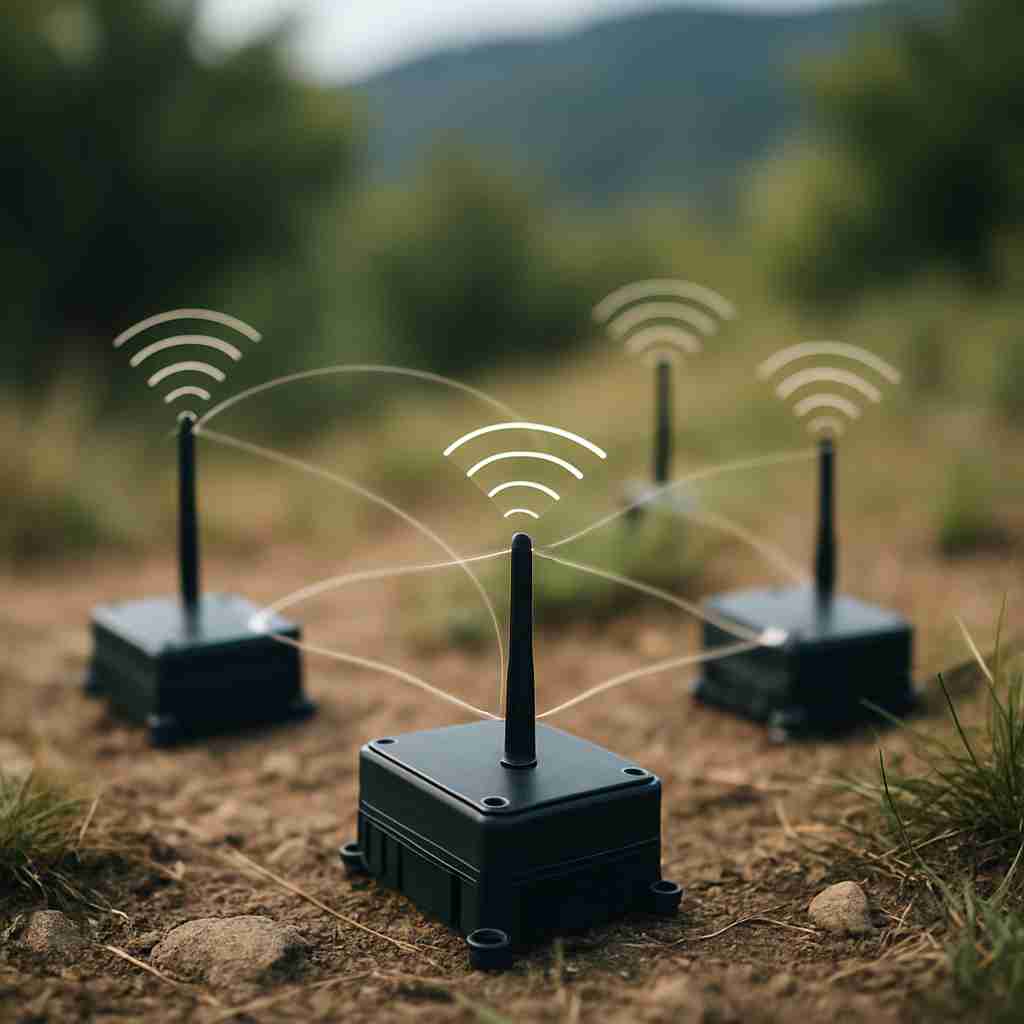
In today’s Internet of Things (IoT) era, achieving effective low-energy wide-range networks—even outside traditional grid boundaries—is essential. The LoRa mesh networking framework offers a promising path toward establishing sturdy standalone communication networks. This article explores the LoRaWAN protocol by investigating distributed mesh networks, energy-efficient IoT applications, and the autonomous network recovery protocols that contribute to the robust IoT connectivity.
Understanding LoRa Mesh Networking
LoRa, short for Long Range, serves as a powerful foundation for LoRa mesh technology, especially in standalone IoT communication scenarios. Utilizing low-frequency radio signals, it enables long-range transmission with minimal power consumption. This characteristic sets it apart from traditional wireless networks, which frequently face challenges balancing distance coverage and energy efficiency. By allowing signal propagation over several kilometers without relying on energy-intensive infrastructure, LoRa efficiently supports remote areas, a capability often missing in standard urban networks.
Its unique features make it ideal for mesh networking frameworks, where devices exchange data directly to cover large distances. This method differs from conventional hierarchical network topologies, offering a more flexible and resilient setup that can self-manage and adjust swiftly during real-time conditions.
When wired connectivity isn’t feasible, embracing LoRa mesh technology enables autonomous IoT systems to prosper. It closes communication gaps in agricultural, environmental, and emergency applications, guaranteeing continuous data transmission with minimal infrastructure, and lays the groundwork for innovations requiring consistent, yet power-efficient, wireless communication.
Exploring the LoRaWAN Protocol
The LoRaWAN protocol serves as a key advancement to the LoRa mesh network infrastructure, enhancing it to support efficient communication across expansive networks. Its notable advantage lies in scalability, which allows for the seamless addition of numerous devices within a system. This feature proves essential for the growth-oriented IoT systems where connected sensors can fluctuate widely. Equipped with secured LoRaWAN data transmission, the protocol guarantees that all information exchanged across the network stays shielded from unauthorized breaches, which is critical for preserving data integrity in distributed configurations.
Thanks to its dynamic data rate adjustment capability, LoRaWAN optimizes energy consumption and bandwidth use. By varying data transfer speeds in response to conditions, the protocol helps extend battery longevity—a vital benefit for standalone IoT communication where recharging might not be feasible. Moreover, the protocol enables smooth existing system integration, allowing new and heritage technologies to coexist effortlessly. Within decentralized wireless networking, LoRaWAN ensures efficient, low-latency communication while boosting reliability. These qualities establish it as a fundamental component in deploying effective self-sufficient communication infrastructure using LoRa mesh technology.
Implementing Off-Grid Communication Solutions
Deploying LoRa mesh technology within standalone communication networks presents an effective way to maintain uninterrupted connectivity. This setup requires placing nodes thoughtfully to guarantee broad network reach. Devices such as gateways, antennas, and nodes are chosen considering their range and power efficiency, frequently utilizing solar-powered connected devices to boost eco-friendliness. The process begins with thorough site evaluations to find the best locations for nodes, followed by the configuration of gateways to establish communication.
Obstacles might involve interference caused by the terrain or the upfront investment for hardware. Nevertheless, leveraging high-gain directional antennas for enhanced signal can reduce signal disruption, while the falling costs of technology help alleviate financial barriers.
The practical usage of LoRa mesh technology clearly demonstrates its importance. In smart agriculture IoT solutions, it supports soil moisture measurement to fine-tune irrigation, thereby elevating crop productivity and saving water. During disaster response, these autonomous communication networks serve as reliable channels when conventional infrastructure collapses. Similarly, in wildlife conservation, animal monitoring systems enable non-intrusive tracking of threatened species, aiding efforts to safeguard their habitats. Such deployments emphasize LoRaWAN’s role in enabling remote IoT connectivity, empowering vital industries with its durable, power-efficient wireless transmission.
Decentralized and Self-Healing Networks
Distributed mesh networks, such as the LoRa mesh topology design, present a robust approach to sustaining connectivity even when individual nodes fail. Unlike conventional networks that depend on a centralized hub, distributed wireless networking inherently provides greater durability. Within the LoRa mesh topology design, every node operates independently while collaborating, allowing the network to self-organize and autonomously repair itself in real time.
Should a node lose connection, data is promptly rerouted through alternative routes, ensuring continuous communication channels. This autonomous network recovery protocol eliminates service interruptions and greatly enhances the IoT connectivity robustness in demanding settings. Such flexibility is vital for fields like smart agriculture IoT solutions and disaster response, where uninterrupted data transmission is essential despite severe conditions. By evenly balancing the network load, these autonomous mesh networks minimize congestion and mitigate risk, establishing a durable network foundation capable of supporting diverse low power wide area connectivity applications.
As the need for reliable, resilient communication infrastructures intensifies, distributed mesh networks highlight their crucial role in advancing the future landscape of wireless communication and IoT network deployments.
Low-Power IoT Applications and Future Prospects
Energy efficiency remains a top priority within the field of low-power IoT applications. Excelling in this area is LoRa mesh network infrastructure, which proves vital for gadgets demanding lengthy battery longevity and cost-effective performance. Consuming minimal power, this networking framework gives a notable edge compared to conventional wireless systems. Its naturally low-energy consumption enables IoT sensors to function for years on compact batteries, paving the way for sustainable and budget-friendly implementations.
Looking ahead, the scope for LoRa mesh network infrastructure in IoT is vast. Sectors such as smart agriculture, environmental observation networks, and city planning are poised to gain immensely from this highly efficient technology. For example, farmers can install widespread sensor networks across extensive farmland to track soil moisture and weather patterns, helping conserve water and boost harvests. Meanwhile, urban areas can employ these networks to collect information for adaptive traffic control or optimize waste management routes.
Emerging technology trends indicate enhanced efficiency and tighter integration with AI, fostering more intelligent and autonomous IoT solutions. Constant innovation suggests an increasing dependence on LoRaWAN as the foundational infrastructure for upcoming IoT generations, promising lowered operational expenses and improved network durability across global industries.
Conclusions
By harnessing decentralized wireless networking, low-energy consumption, and resilient network management protocols, LoRa mesh networking presents an effective approach for remote IoT connectivity needs. Strategically implementing a LoRa mesh communication architecture alongside LoRaWAN enables the creation of flexible and robust communication infrastructures, empowering IoT deployments in isolated regions while enhancing connectivity and operational performance.